What is Bollinger Bands?
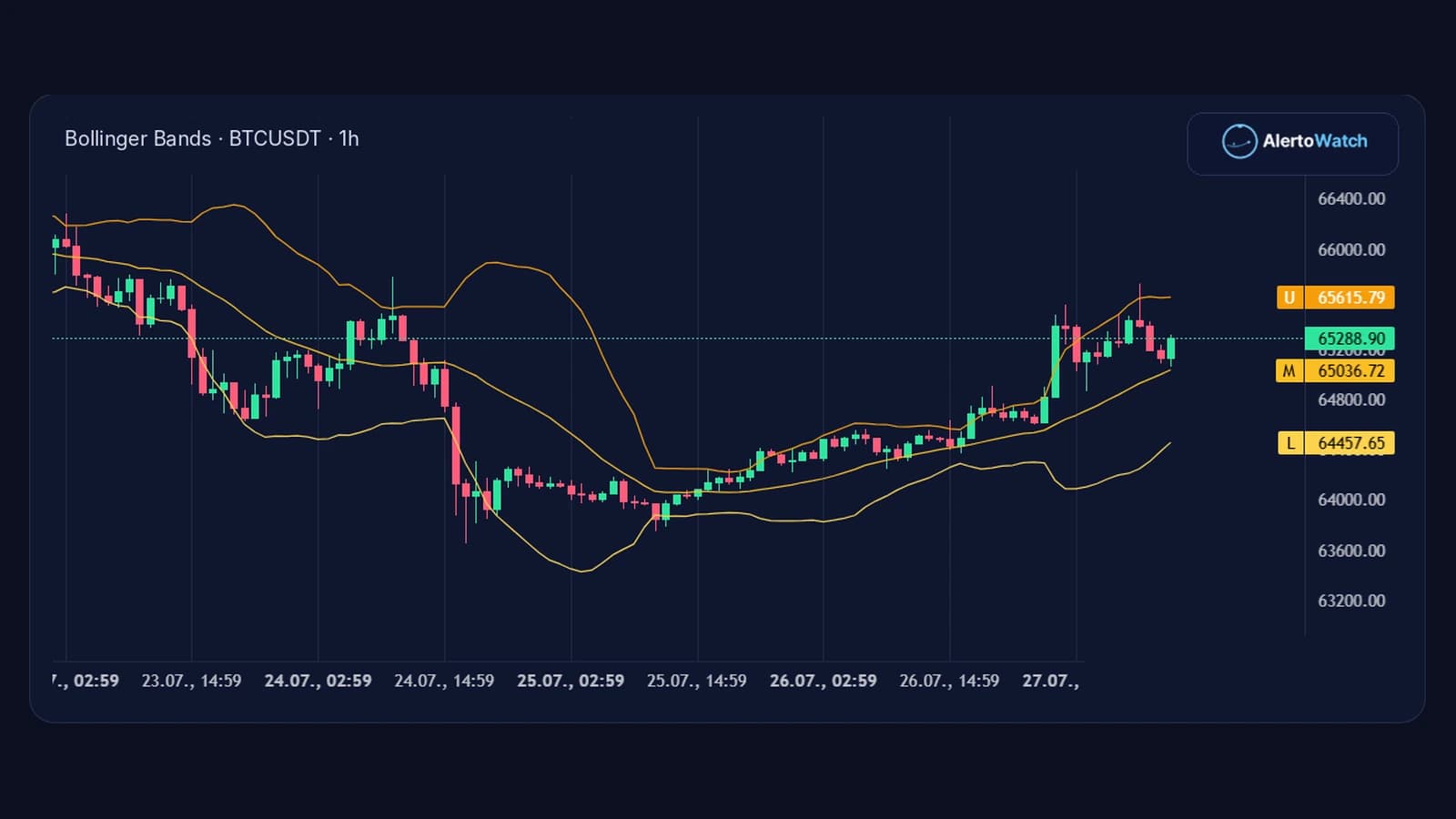
A standard Bollinger Band set contains a middle moving average and two outer bands. The outer bands respond to recent volatility.

Volatility
Bollinger Bands are a volatility indicator built around a moving-average center line with upper and lower bands. AlertoWatch supports the documented fixed 20-period, two-deviation definition.
A standard Bollinger Band set contains a middle moving average and two outer bands. The outer bands respond to recent volatility.
As measured volatility rises, the distance between the outer bands generally expands. When volatility falls, the bands generally contract. Price can be compared with or cross a selected band.
Price reaching or closing outside a band can describe strong movement relative to recent volatility; it is not automatically a reversal signal. Narrower or wider bands describe changing volatility conditions.
Illustrative AlertoWatch chart
Turn the indicator relationship into a precise monitored condition. These are plain-English rule ideas, not recommendations or promises about market outcomes.
Bollinger Bands do not determine whether price will continue or reverse. In strong trends, price can remain close to one band for an extended period.