What is EMA?
An EMA is a trend-following moving average designed to be more responsive to recent price changes than a simple moving average.

Trend
The Exponential Moving Average, or EMA, gives more weight to recent prices. It provides moving-average context that usually reacts faster than a comparable SMA.
An EMA is a trend-following moving average designed to be more responsive to recent price changes than a simple moving average.
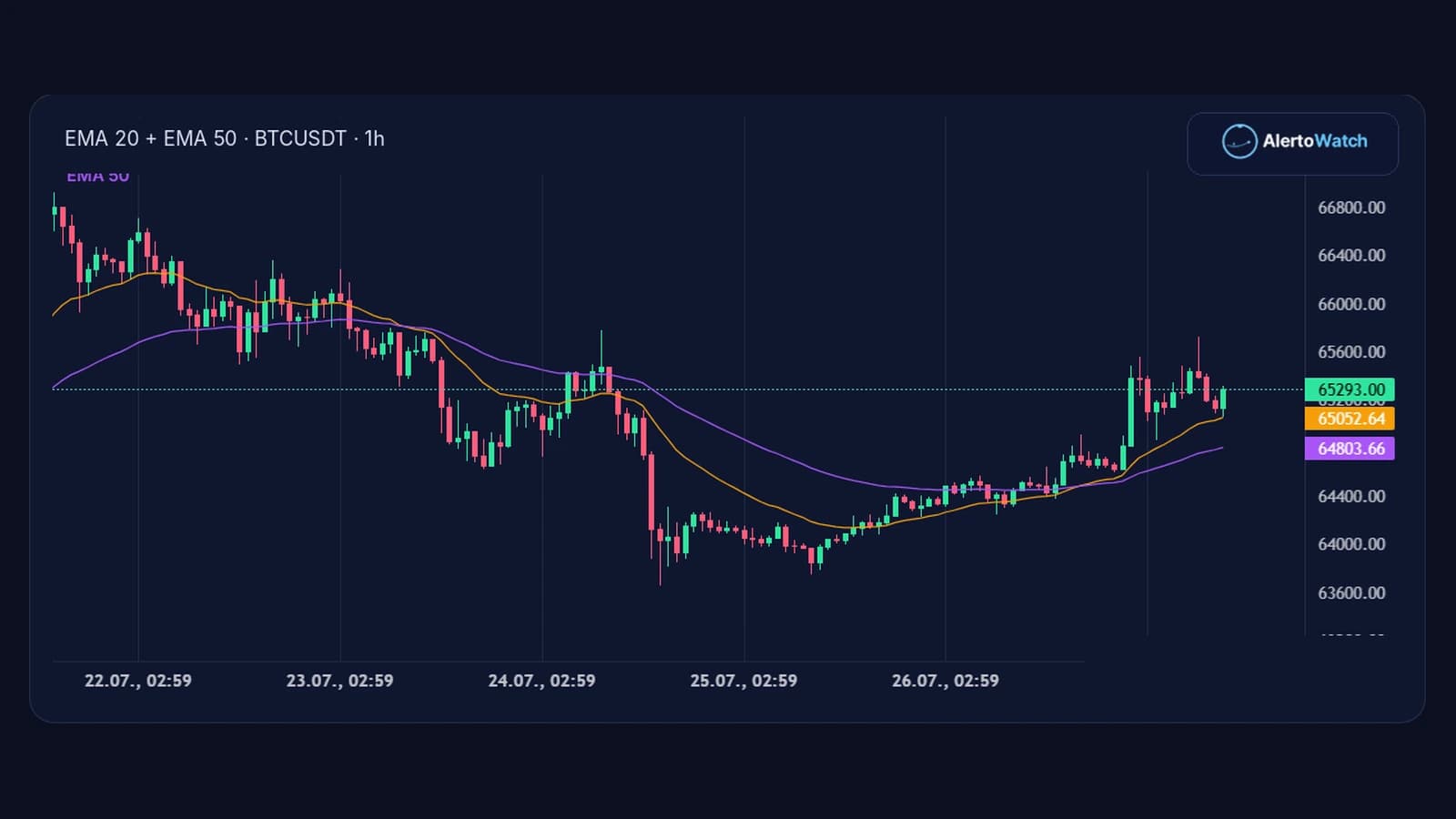
Recent data carries more influence in the calculation, so an EMA usually turns faster than an SMA with the same length. Price can be compared with one EMA, or two EMA lengths can be compared with each other.
Price above a selected EMA can be interpreted as stronger trend context. A shorter EMA crossing a longer EMA is often monitored as a change in trend behavior, not as a guaranteed outcome.
Illustrative AlertoWatch chart
Turn the indicator relationship into a precise monitored condition. These are plain-English rule ideas, not recommendations or promises about market outcomes.
Related alert templates
Review an EMA 13 crossing above EMA 50 example.
View templateEMA still lags price and can produce frequent false shifts in range-bound conditions. Faster response does not remove the need for context.